 |
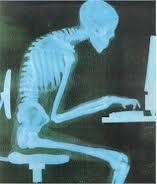
| Is this you?? |
Practicing in the RTP area I see daily what the effects of sitting at the desk all day can bring.
From the time we were children, we were often taught to have good posture - "Don't slouch, sit up straight, with your shoulders back". Today, we know that having poor posture can have adverse effects on our nervous system which ultimately can lead to a multitude of chronic problems like carpal tunnel syndrome, recurrent headaches, neck and shoulder pain as well as mid and low back problems. Contributing to this problem is the often overlooked importance of how we organize our workspace and materials around us, encapsulated in the term "ergonomics", which can adversely affect the stress and strain on our bodies.
Posture
No matter where we are and what we're doing and in what position we are in, there is an optimal position our body can and should be in to decrease stress on both the muscles, spine as well as the joints of the body. If we are looking at posture in a purely natural state, that is without any external forces like chairs, etc., our posture is essentially determined by the boney structures of the spine and extremities as well as the muscles surrounding the joints and spine and their ability to counteract the force of gravity.
"Proper posture" is somewhat of a subjective term, due to the fact that proper posture for one person may not be proper for another person, based on their body type, structural make up and other issues like prior muscle or bone surgery and other previous injuries. However, a person's optimal posture is that which causes the least amount of strain and/or stress on their spine, ligaments, muscles and other joints of their body. This means having one's body in a position where all joint surfaces whether they may be in the spine or in the knee in a neutral position.
Some of the distinctive features of neutral posture are:
- ¨ Head is balance over the spine (ears over shoulders)
- ¨ Shoulders are straight (shoulders over hips)
- ¨ Thumbs point forward
- ¨ Pelvis is tucked in (hips over knees)
- ¨ Knees stay over the feet (when bending)
- ¨ Heels are perpendicular to the ground
In a perfect world, everyone would be in a neutral posture everyday, all the time. But, in reality, the position our body's are in varies depending on what line of work we're in and what time of day it is. It'll also vary quite a bit if in fact you've previously injured your back or neck.
In a recent survey by GRD BioTech, Inc., poor posture was most frequently blamed on:
- 1. Lack of exercise
- 2. Weak muscles
- 3. Obesity
- 4. Lack of body awareness
- 5. Excessive pronation (or rolling in) of the feet
If you find that any of these issues are of a concern to you, there may be undue stress and wear and tear on your body that you don't need to endure.
So....What's The Solution?
If like many people, you work in an office......, If you're a student or you're a seasoned hiker/backpacker and carry a full load of books or gear everyday this is for you.
What Can I Do Proactively?
Most importantly, you should be evaluated so that your current posture can be established and risk factors or weak points can be identified. Consult with
Dr.Craig French on specific strengthening exercises you can do to strengthen your postural muscles and improve your overall balance. Or, if you're suffering from sleepless nights or have trouble with your sitting during the day, consult our office to get helpful tips.
Are You A Student or Do You Do A Lot of Desk Work?
What pains me more than anything is seeing a student studying while lying on their stomach or with their neck cranked by having their notes on their desk. A simple solution would be to pick up a note or book prop/document holder at your local office supply store and place your work on it to relieve the stress on your neck and spine. And above all, work and study while sitting in a proper chair and absolutely not while lying down.
Ergonomics
Definition - the study of the relationship between individuals and their work or working
environment, especially with regard to fitting jobs to the needs and abilities
of workers. The essential nature of ergonomics is the convergence of human
biology (especially anatomy, physiology, and psychology of problems of
Man at work) (New Scientist). - The World Book Dictionary Volume One
A-K, 1983 Doubleday & Company, Inc.
Ergonomics is about organizing the workplace to fit the worker.
The origin of the work comes from Greek: "Ergon" is work and "Nomos" is natural laws. This means re-adjusting your equipment and workplace to fit your needs, and becoming more aware of your posture in your work environment.
Why Should I Care?
- ¨ Having proper ergonomics at your workplace is crucial to having proper posture.
- ¨ To help prevent Repetitive Strain Injuries (RSI) such as Carpal Tunnel Syndrome
- ¨ To help prevent other ailments such as headaches, eye strain, back and neck strains
- ¨ To help reduce stress
- ¨ To help increase productivity
Weather you work at a lumber mill or as a computer programmer, ergonomics plays an extremely important role in helping you to do your job efficiently as well as with the least amount of stress/strain on your body.
With the explosion in the use of computers or video display terminals over the last 20 years, much of ergonomics research has been focused on this area. In particular, how improper ergonomics can lead to visual problems and fatigue and musculoskeletal problems.
Think It's Not A Problem?
Check out these stats..........
.....ergonomics-related injuries still account for one third of all workplace injuries, and they result in the longest absences from work - a median of 27 days in the case of carpal tunnel syndrome. Puget Sound Business Journal, April 6-12, 2001
According to the Occupational Health & Safety Administration (OHSA), 1.8 million workers have musculoskeletal injuries related to ergonomic factors, and 600,000 people miss some work each year because of them. The Seattle Times, November 12, 2000
"The consequences of these injuries are serious at work and at home. A worker with numb hands can't firmly grip work tools or a toothbrush. A worker with an injured back can't lift boxes at work or their children at home".
Michael Silverstein, M.D.
Assistant Director, WISHA Services Division
Department of Labor and Injuries - Washington
The Worst Jobs For Ergonomic Injuries
Occupation Number of Musculoskeletal Disorders
(1) Nursing Aides, orderlies, attendants 44,300
(2) Truck Drivers 41,700
(3) Nonconstruction Laborers 32,800
(4) Assemblers 17,900
(5) Janitors and Cleaners 14,100
(6) Registered Nurses 13,100
(7) Stock handlers, baggers 12,400
(8) Construction laborers 11,000
(9) Cashiers 9,700
(10) Sales supervisors, proprietors 9,300
Source: Bureau of Labor and Statistics 2001
What Can I Do?
While setting up one's workstation varies greatly from individual to individual, very general tips and guidelines should be addressed.
Keyboards: Your wrist position is key
Many agree that the ideal computing position is to be sitting upright or slightly reclined. Your shoulders should be straight, upper arms hanging straight down, close to your body, and elbows at a 90-degree or greater angle. Your forearms and hands should b flat and your hands relaxed......this leaves your wrists in a neutral position. There are various ergonomically designed designed split keyboards that are becoming increasingly popular that help with your wrist position.
Mouse: Does it fit your hand?
Not only do people's hands come in all different sizes, so do mice. When looking for a mouse to purchase, look for one that isn't too big or too small but one that fits snugly under your relaxed hand. The bottom of your hand should feel the mouse, and the point where your hand turns into your wrist should be on the table. Most importantly, it needs to fit well enough so you can click easily and know the click is successful. This helps to minimize stress on the wrist and shoulder. For those suffering form wrist and/or shoulder pain, there are foot-operated mice on the market that may be worth looking at.
Monitor: eye level and minus glare
If your monitor isn't positioned correctly, your computer monitor can cause neck pain, shoulder pain, and eyestrain from glare. As a general rule, you should keep it in front of you such that you don't have to turn your head either way to look at it straight on and it should be at an arm's length in distance. Your neck should be straight, not leaning forward. The top of the screen should be directly level with your eyes. The monitor should be tilted slightly upward. Another important component to your monitor to consider is glare. Poor positioning related to your windows or lighting could result in eyestrain and headaches. Adding a glare filter to your monitor can also minimize the affects of improper lighting.
Document Holders: an absolute necessity
Using a document holder near the monitor near the monitor will help keep your neck in neutral position and helps you to avoid awkward straining.
Chair: most important component?
A proper adjustable chair is the most important part of your workstation, because it affects your position more than just about anything else. You want a chair that allows you to customize the fit. A preferable chair is one that allows you to sit up straight or slightly reclined with your back snug against the back of the chair one that supports your low back comfortably. Your feet should also be flat on the floor or on a foot rest.
Using Phones A Lot?
Yes, that's for all you office and tech support people. A headset is an absolute necessity if you are on the phone a lot. Taking steps to make your workstation ergonomically correct, but cradling the phone on your neck for long phone calls doesn't make sense.
Time Management
Our body is not designed to be in one place, doing one thing for long periods of time. So, it's important to schedule breaks from repetitive activities and learn stretches that reduce fatigue in your muscles. As a general rule of thumb you should get up at least once every 1-2 hours and stretch and walk around a bit to keeps the circulation in your legs going. A great idea is to get up and get some water.
Where Should I Start?
There are a lot of resources at stores like Relax The Back Store, Office Max and Office Depot which carry a wide assortment of ergonomically correct products that will save you time and money in the long run.
For more information on ergonomics call
Dr. Craig French to help evaluate your work habits.


