Showing posts with label Dr.Craig French. Show all posts

Monday, November 21, 2011

Diet Soda and Your Health....

Over the many years of practice, I have the same questions asked of me over and over..one is, is drinking soda or diet soda bad for me?  There is only one answer to this ABSOLUTELY YES!!!  I causes everything from Cancer, Obesity, Heart disease, Strokes and other life threatening diseases.  Below are a couple of wonderful articles from Dr. Mercola I think you will find helpful.


Drinking This "Popular Poison" is Worse than Smoking


Striking Similarities Between the Soda Industry and Big Tobacco

If I asked you to quickly recall a commercial or slogan from leading soda companies, like Coca-Cola or Pepsi, could you do it?
 Chances are you'd have no trouble recalling the friendly polar bear commercials or "the real thing" logo, and if you asked your kids, they'd probably come up with a few too.
This is just the tip of the iceberg for how beverage big-wigs have gotten their products firmly embedded into the homes of millions of Americans and others worldwide. Coca-Cola, for instance, spends close to $3 billion a year on advertising. With that amount of money it's no wonder the company has managed to hold on to its wholesome reputation.

They, and other beverage giants, are also in the habit of forming strategic alliances with health organizations that make it appear as though they are looking out for your health, which is about as laughable as Big Tobacco sponsoring a marathon. And like Big Tobacco, they also create front groups to fight anti-soda legislation and science.
For instance, as Time magazine reported:
  • The American Beverage Association, which represents Coca-Cola, Pepsi and other soft drink producers, has attacked suggestions to tax soda as "discriminatory." Their organization is touted as a "neutral forum," but in reality is devoted to discrediting negative press against soft drinks. For instance, in relation to obesity, ABA states, "All of our industry's beverages can be enjoyed as part of a balanced lifestlye."
  • The soda industry has created the front group Americans Against Food Taxes, which runs anti-tax campaigns. As Kelly Brownell wrote in Time:

    "The name of the group implies a patriotic, grass roots movement, not a highly financed entity initiated and organized by industry."
  • Another industry-created front group, Foundation for a Healthy America, recently donated $10 million to the Children's Hospital of Philadelphia to research and prevent childhood obesity! Diet Coke has also teamed up with the National Heart, Lung, and Blood Institute (NHLBI) to raise awareness for women's heart health programs and was the official "Beverage of Choice" for the 2010 winter Olympics.
  • The soda industry funds research to discredit links between soda drinking and health problems. Brownwell writes:

    "The tobacco industry paid scientists who did research disputing links between smoking and lung cancer, the addictive nature of nicotine, and the dangers of second-hand smoke. The soda industry funds scientists who reliably produce research showing no link between SSB [sugar-sweetened beverage] consumption and health. The tobacco industry bought favor from community and national organizations by giving large donations. In an ironic twist, Coca Cola and PepsiCo are corporate sponsors of the American Dietetic Association."
The Coca-Cola Company Beverage Institute for Health and Wellness (isn't that name an oxymoron?) even creates continuing education courses for registered dietitians!

The Top Reason to Give Soda the Boot …

Some of you reading this are undoubtedly thinking, how bad could soda really be? From my perspective, there is absolutely NO REASON you or your kids should ever drink soda. If you were stranded in the middle of a desert with no other fluid available, then maybe, but other than that … none, nada, zip, zero. No excuses.

From a health perspective, drinking Coke or any soft drink is a disaster. Just one extra can of soda per day can add as much as 15 pounds to your weight over the course of a single year, not to mention increase your risk of diabetes by 85 percent. The primary reason why soda is so dangerous to your health?

Fructose.
The fructose content of the high fructose corn syrup (HFCS) used in many popular soda brands has been sorely underestimated. Around 100 years ago the average American consumed a mere 15 grams of fructose a day, primarily in the form of fruit. One hundred years later, one fourth of Americans are consuming more than 135 grams per day, largely in the form of soda.
Fructose at 15 grams a day is harmless (unless you suffer from high uric acid levels).

However, at nearly 10 times that amount it becomes a major cause of obesity and nearly all chronic degenerative diseases. Instead of consisting of 55 percent fructose and 45 percent glucose, many soda brands, including Coke, Pepsi and Sprite, contain as much as 65 percent fructose, nearly 20 percent higher than originally believed. According to one study, the mean fructose content of all 23 sodas tested was 59 percent -- higher than claimed by the industry. When you consider that Americans drink an average of 53 to 57 gallons of soda per year (depending on the source of your statistics), this difference in actual fructose content could make a huge difference in your health.


Diet Soda is Not a "Healthier" Alternative

By Dr. Mercola

There are other reasons aside from weight gain to think twice before drinking diet soft drinks. In fact, there are already hundreds of published studies linking artificial sweeteners like aspartame, which is widely used in diet soda, to serious health complications. Cori Brackett's documentary film Sweet Misery is an excellent summary of the problems with aspartame.

You can also view my interview with Victoria Innes-Brown, who over a 2.5-year period performed a set of meticulous and detailed animal experiments, documenting the effects of using aspartame liquid comparable to diet soda. This included not only large tumors but also neurological effects, paralysis, skin disorders and symptoms of cerebral palsy.
Recent research has also linked diet soda consumption to higher rates of strokes, heart attacks and other lethal vascular events as well as metabolic syndrome.

There is literally enough evidence showing the dangers of consuming artificial sweeteners to fill an entire book -- which is exactly why I wrote Sweet Deception. If you or your loved ones drink diet beverages or eat diet foods, this book will explain how you've been deceived about the truth behind artificial sweeteners like aspartame and sucralose

Thursday, November 17, 2011

Nutritional Tips..

Being a Doctor of Chiropractic, I incorporate nutrition into my philosophy of wellness it's not about a certain diet, but about a lifestyle.  Here are a few of the items that can help you along the way.


Healthy Oils


Healthy Oils

There are many healthy oils, such as olive oil, sesame seed oil, flaxseed oil, grape seed oil and canola oil. To maximize their health benefits good oils need to be used properly. Keep it in a dark bottle or in your refrigerator—that's how to keep it healthy so it doesn't go rancid. Healthy oils are delicate, you have to treat them delicately.

Overheating good oils during cooking can damage them. Don't cook the oil, cook the food, which means put a tiny bit of oil in the pan, put the food in the oil and then put the food with the oil on it in the pan—that way the oil is preserved. It doesn't heat up and it doesn't get damaged by the heat.


Garlic


Garlic is great for our bodies. It actually helps the bacteria in your intestines and it also relaxes the arteries and it has a benefit with cancer. It's a great thing to add to your diet. It's present in a lot of cultures—we've forgotten it in America.
Salad dressing made with fresh garlic, lemon and olive oil is one of Oprah's favorites. It's a perfect dressing, It's the best way to have olive oil because you haven't heated it and you haven't damaged it.


Tomato Sauce


Eating 10 tablespoons of tomato sauce per week. Inside the tomato is a chemical called lycopene. This chemical has a wonderful effect—it's an antioxidant.
There are added benefits from eating tomato sauce or paste as opposed to plain tomatoes. A raw tomato is fine, too, but if you get a little fat with it—either with some nuts or a little olive oil and dressing—then it's perfect. It helps you absorb it better into your intestinal system.


Spinach


Jam-packed with nutrients, spinach is out-of-sight. This is the best thing for your eyes, It's better than carrots, and a lot of macular degeneration—which is a tragic ailment that affects vision—can actually be avoided by eating these kinds of foods that are rich in carotenoids and also have folic acids and a lot of other benefits. Sauté spinach with a little garlic and olive oil for a perfect side dish.


Raw Nuts


To maximize the benefits of the healthy oils found in nuts such as almonds, hazelnuts or walnuts they should be eaten raw and stored in the refrigerator. When you roast a nut, the healthy oils that are in there become damaged. The oils aren't supposed to be heated and damaged—they're supposed to be taken in their natural form.


Pomegranates (there perfect time of year to enjoy them)


Research on the health benefits of pomegranates has shown promising results. We've done studies on them showing how they actually can change the way your arteries age—it's a very potent antioxidant, It also probably affects cancer rates, especially prostate cancer, but those studies haven't been finished yet.
Not only do pomegranates have extraordinary health benefits—they taste good, too. It's a little sweet for me so I mix it with water, but pomegranates or their juice are worth trying out.

Tuesday, November 15, 2011

Good Posture..what is that!!

 To most people, "good posture" simply means sitting and standing up straight. Few of us realize the importance of posture to our health and performance.


The human body craves alignment. When we are properly aligned, our bones, not our muscles, support our weight, reducing effort and strain. The big payoff with proper posture is that we feel healthier, have more energy, and move gracefully. So while the word "posture" may conjure up images of book-balancing charm-school girls, it is not just about standing up straight. It’s about being aware of and connected to every part of your self.

Posture ranks right up at the top of the list when you are talking about good health. It is as important as eating right, exercising, getting proper rest and avoiding potentially harmful substances like alcohol, drugs, and tobacco. Good posture is a way of doing things with more energy, less stress and fatigue. Without good posture, you cannot really be physically fit. Without good posture, you can actually damage your spine every time you exercise.

Ideally, our bones stack up one upon the other: the head rests directly on top of the spine, which sits directly over the pelvis, which sits directly over the knees and ankles. But if you spend hours every day sitting in a chair, if you hunch forward or balance your weight primarily on one leg, the muscles of your neck and back have to carry the weight of the body rather than it being supported by the spine. The resulting tension and joint pressure can affect you not only physically, but emotionally, too, -- from the predictable shoulder and back pain to headaches, short attention span, and depression.

Poor posture distorts the alignment of bones, chronically tenses muscles, and contributes to stressful conditions such as loss of vital lung capacity, increased fatigue, reduced blood and oxygen to the brain, limited range of motion, stiffness of joints, pain syndromes, reduced mental alertness, and decreased productivity at work. According to the Nobel Laureate Dr. Roger Sperry, "the more mechanically distorted a person is, the less energy is available for thinking, metabolism, and healing."

The most immediate problem with poor posture is that it creates a lot of chronic muscle tension as the weight of the head and upper body must be supported by the muscles instead of the bones. This effect becomes more pronounced the further your posture deviates from your body’s center of balance.

To illustrate this idea further, think about carrying a briefcase. If you had to carry a briefcase with your arms outstretched in front of you, it would not take long before the muscles of your shoulders would be completely exhausted. This is because carrying the briefcase far away from your center of balance places undue stress on your shoulder muscles. If you held the same briefcase down at your side, your muscles would not fatigue as quickly, because the briefcase is closer to your center of balance and therefore the weight is supported by the bones of the skeleton, rather than the muscles. 

In some parts of the world, women can carry big pots full of water from distant water sources back to their homes. They are able to carry these heavy pots a long distance without significant effort because they balance them on the top of their heads, thereby carrying them at their center of balance and allowing the strength of their skeleton to bear the weight, rather than their muscles. 

Correcting bad posture and the physical problems that result can be accomplished in two ways. The first is by eliminating as much "bad" stress from your body as possible. Bad stress includes all the factors, habits, or stressors that cause your body to deviate from your structural center. Bad stress can result from a poorly adjusted workstation at work, from not having your seat adjusted correctly in your car, or even from carrying too much weight around in a heavy purse or backpack. 

The second is by applying "good" stress on the body in an effort to move your posture back toward your center of balance. This is accomplished through a series of exercises, stretches, adjustments, and changes to your physical environment, all designed to help correct your posture. Getting your body back to its center of balance by improving your posture is critically important to improving how you feel. If you would like to have your posture evaluated call Dr. French at Chiropractic Wellness at Brier Creek today to schedule your exam.

Monday, November 14, 2011

What is Wellness?

The main difference between wellness care and standard medical care is that wellness care seeks to turn on the natural healing ability. Wellness care does not add something to the system, instead it  removes anything that might interfere with normal function. Wellness care trusts that the body would know what to do if nothing were interfering with it. Standard medical care, on the other hand, seeks to treat a symptom by adding something from the outside – a medication, a surgery or procedure.  

Inside Out vs. Outside In

If a patient has high blood pressure, a standard medical approach would be to choose a drug that lowers blood pressure, and ask the patient to take the drug. This may serve to lower the blood pressure, but ignores the underlying cause that is making the blood pressure high, and runs the risk of side effects complicating the person’s recovery. Whether it’s a nutritional issue, faulty control by the nerve system or a manifestation of stress, the medication could decrease the blood pressure, leaving the problem causing the symptom of high blood pressure unaddressed.

The Wellness Approach

Wellness is a state of optimal conditions for normal function… and then some. The wellness approach is to look for underlying causes of any disturbance or disruption (which may or may not be causing symptoms at the time) and make whatever interventions and lifestyle adjustments would optimize the conditions for normal function. That environment encourages natural healing, and minimizes the need for invasive treatment, which should be administered only when absolutely necessary. When the body is working properly, it tends to heal effectively, no matter what the condition. When the body heals well and maintains itself well, then there is another level of health that goes beyond “asymptomatic” or “pain-free” which reveals an open-ended opportunity for vitality, vibrant health, and an enhanced experience of life.This is true for mental and emotional health as well as physical health. While some people may suffer psychological disorders, creating an atmosphere of mental and emotional wellness will address all but the most serious problems.

Tuesday, November 8, 2011

Posture and Ergonomics..

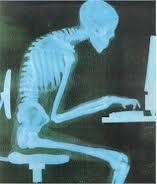
Is this you??
Practicing in the RTP area I see daily what the effects of sitting at the desk all day can bring. 

From the time we were children, we were often taught to have good posture - "Don't slouch, sit up straight, with your shoulders back".  Today, we know that having poor posture can have adverse effects on our nervous system which ultimately can lead to a multitude of chronic problems like carpal tunnel syndrome, recurrent headaches, neck and shoulder pain as well as mid and low back problems.  Contributing to this problem is the often overlooked importance of how we organize our workspace and materials around us, encapsulated in the term "ergonomics", which can adversely affect the stress and strain on our bodies.

Posture
No matter where we are and what we're doing and in what position we are in, there is an optimal position our body can and should be in to decrease stress on both the muscles, spine as well as the joints of the body.  If we are looking at posture in a purely natural state, that is without any external forces like chairs, etc., our posture is essentially determined by the boney structures of the spine and extremities as well as the muscles surrounding the joints and spine and their ability to counteract the force of gravity. 

"Proper posture" is somewhat of a subjective term, due to the fact that proper posture for one person may not be proper for another person, based on their body type, structural make up and other issues like prior muscle or bone surgery and other previous injuries.  However, a person's optimal posture is that which causes the least amount of strain and/or stress on their spine, ligaments, muscles and other joints of their body.  This means having one's body in a position where all joint surfaces whether they may be in the spine or in the knee in a neutral position.    

Some of the distinctive features of neutral posture are:
  
  • ¨ Head is balance over the spine (ears over shoulders)
  • ¨ Shoulders are straight (shoulders over hips)
  • ¨ Thumbs point forward
  • ¨ Pelvis is tucked in (hips over knees)
  • ¨ Knees stay over the feet (when bending)
  • ¨ Heels are perpendicular to the ground
In a perfect world, everyone would be in a neutral posture everyday, all the time.  But, in reality, the position our body's are in varies depending on what line of work we're in and what time of day it is.  It'll also vary quite a bit if in fact you've previously injured your back or neck. 

In a recent survey by GRD BioTech, Inc., poor posture was most frequently blamed on:

  • 1. Lack of exercise
  • 2. Weak muscles
  • 3. Obesity
  • 4. Lack of body awareness
  • 5. Excessive pronation (or rolling in) of the feet
 If you find that any of these issues are of a concern to you, there may be undue stress and wear and tear on your body that you don't need to endure.
So....What's The Solution?
 
If like many people, you work in an office......,   If you're a student or you're a seasoned hiker/backpacker and carry a full load of books or gear everyday this is for you.
 
What Can I Do Proactively?
Most importantly, you should be evaluated so that your current posture can be established and risk factors or weak points can be identified.  Consult with Dr.Craig French on  specific strengthening exercises you can do to strengthen your postural muscles and improve your overall balance.  Or, if you're suffering from sleepless nights or have trouble with your sitting during the day, consult our office to get helpful tips. 
 
Are You A Student or Do You Do A Lot of Desk Work?
What pains me more than anything is seeing a student studying while lying on their stomach or with their neck cranked by having their notes on their desk.  A simple solution would be to pick up a note or book prop/document holder at your local office supply store and place your work on it to relieve the stress on your neck and spine.  And above all, work and study while sitting in a proper chair and absolutely not while lying down.  

 
 Ergonomics
 
Definition - the study of the relationship between individuals and their work or working
                    environment, especially with regard to fitting jobs to the needs and abilities
                    of workers.  The essential nature of ergonomics is the convergence of human
                    biology (especially anatomy, physiology, and psychology of problems of 
                    Man at work) (New Scientist). - The World Book Dictionary Volume One
                    A-K, 1983 Doubleday & Company, Inc.
 
Ergonomics is about organizing the workplace to fit the worker.
The origin of the work comes from Greek: "Ergon" is work and "Nomos" is natural laws.  This means re-adjusting your equipment and workplace to fit your needs, and becoming more aware of your posture in your work environment.  

Why Should I Care?
 
  • ¨ Having proper ergonomics at your workplace is crucial to having proper posture.
  • ¨ To help prevent Repetitive Strain Injuries (RSI) such as Carpal Tunnel Syndrome
  • ¨ To help prevent other ailments such as headaches, eye strain, back and neck strains
  • ¨ To help reduce stress
  • ¨ To help increase productivity
Weather you work at a lumber mill or as a computer programmer, ergonomics plays an extremely important role in helping you to do your job efficiently as well as with the least amount of stress/strain on your body. 
With the explosion in the use of computers or video display terminals over the last 20 years, much of ergonomics research has been focused on this area.  In particular, how improper ergonomics can lead to visual problems and fatigue and musculoskeletal problems.
Think It's Not A Problem?
Check out these stats..........
.....ergonomics-related injuries still account for one third of all workplace injuries, and they result in the longest absences from work - a median of 27 days in the case of carpal tunnel syndrome.   Puget Sound Business Journal, April 6-12, 2001
 
According to the Occupational Health & Safety Administration (OHSA), 1.8 million workers have musculoskeletal injuries related to ergonomic factors, and 600,000 people miss some work each year because of them.  The Seattle Times, November 12, 2000
 
"The consequences of these injuries are serious at work and at home.  A worker with numb hands can't firmly grip work tools or a toothbrush.  A worker with an injured back can't lift boxes at work or their children at home".
                                                            Michael Silverstein, M.D.
                                                            Assistant Director, WISHA Services Division
                                                            Department of Labor and Injuries - Washington
 
The Worst Jobs For Ergonomic Injuries
 
Occupation                                                Number of Musculoskeletal Disorders
(1) Nursing Aides, orderlies, attendants            44,300
(2) Truck Drivers                                            41,700
(3) Nonconstruction Laborers                           32,800
(4) Assemblers                                               17,900
(5) Janitors and Cleaners                                 14,100
(6) Registered Nurses                                      13,100
(7) Stock handlers, baggers                              12,400
(8) Construction laborers                                  11,000
(9) Cashiers                                                      9,700
(10) Sales supervisors, proprietors                      9,300
Source: Bureau of Labor and Statistics 2001
What Can I Do?
While setting up one's workstation varies greatly from individual to individual, very general tips and guidelines should be addressed.  

Keyboards: Your wrist position is key 
Many agree that the ideal computing position is to be sitting upright or slightly reclined.  Your shoulders should be straight, upper arms hanging straight down, close to your body, and elbows at a 90-degree or greater angle.  Your forearms and hands should b flat and your hands relaxed......this leaves your wrists in a neutral position.  There are various ergonomically designed designed split keyboards that are becoming increasingly popular that help with your wrist position. 

Mouse: Does it fit your hand?
Not only do people's hands come in all different sizes, so do mice.  When looking for a mouse to purchase, look for one that isn't too big or too small but one that fits snugly under your relaxed hand.  The bottom of your hand should feel the mouse, and the point where your hand turns into your wrist should be on the table.  Most importantly, it needs to fit well enough so you can click easily and know the click is successful.  This helps to minimize stress on the wrist and shoulder.  For those suffering form wrist and/or shoulder pain, there are foot-operated mice on the market that may be worth looking at. 

Monitor: eye level and minus glare
If your monitor isn't positioned correctly, your computer monitor can cause neck pain, shoulder pain, and eyestrain from glare.  As a general rule, you should keep it in front of you such that you don't have to turn your head either way to look at it straight on and it should be at an arm's length in distance.  Your neck should be straight, not leaning forward.  The top of the screen should be directly level with your eyes.  The monitor should be tilted slightly upward. Another important component to your monitor to consider is glare.  Poor positioning related to your windows or lighting could result in eyestrain and headaches.  Adding a glare filter to your monitor can also minimize the affects of improper lighting. 

Document Holders: an absolute necessity
Using a document holder near the monitor near the monitor will help keep your neck in neutral position and helps you to avoid awkward straining. 

Chair: most important component?
A proper adjustable chair is the most important part of your workstation, because it affects your position more than just about anything else.  You want a chair that allows you to customize the fit.  A preferable chair is one that allows you to sit up straight or slightly reclined with your back snug against the back of the chair one that supports your low back comfortably.  Your feet should also be flat on the floor or on a foot rest. 

Using Phones A Lot?
Yes, that's for all you office and tech support people.  A headset is an absolute necessity if you are on the phone a lot.  Taking steps to make your workstation ergonomically correct, but cradling the phone on your neck for long phone calls doesn't make sense. 

Time Management
Our body is not designed to be in one place, doing one thing for long periods of time.  So, it's important to schedule breaks from repetitive activities and learn stretches that reduce fatigue in your muscles.  As a general rule of thumb you should get up at least once every 1-2 hours and stretch and walk around a bit to keeps the circulation in your legs going.  A great idea is to get up and get some water. 
 
Where Should I Start?
There are a lot of resources at stores like Relax The Back Store, Office Max and Office Depot which carry a wide assortment of ergonomically correct products that will save you time and money in the long run.
For more information on ergonomics call Dr. Craig French  to help evaluate your work habits.  


Saturday, October 1, 2011

Nervous System..


The Nervous System controls the function of the entire body. The Brain is the control centre, and the spinal cord and nerves are the messengers. When correct spinal alignment is altered, the nerves can be irritated producing pain.

Scientific research has shown that the slightest pressure on the nerve will alter nerve function, producing pain and possibly numbness as in Repetitive Strain Injury. Chiropractic treatment has been found to be most effective in the treatment and management of these conditions. As a result, you may also have referred pain in other parts of your body originating from the spine.


If you live in Durham or the surrounding areas of RaleighMorrisvilleBrier CreekRTP NC, contact Chiropractic Wellness at Brier Creek to get on the road to recovery as soon as possible.

Thursday, September 29, 2011

Chiropractic Facts and Myths!!

Unlike standard medical doctors whom you visit when you have a symptom to be treated, chiropractors offer adjustments to improve spinal alignment and overall well-being before symptoms develop.


As successful as chiropractic has become, there are a lot of myths circulating among the general public. Times have definitely changed for the better, but the fact is that many people still do not understand what chiropractors do. Let's talk about a few of the more common myths about chiropractic.

Myth #1 - Chiropractors are not real doctors.
A chiropractic college grants a D.C. or Doctorate of Chiropractic degree. Chiropractors are licensed as health care providers in every U.S. state and dozens of countries around the world. While the competition for acceptance in chiropractic school is not as fierce as medical school, the chiropractic and medical school curricula are extremely 
rigorous and virtually identical. In fact, chiropractors have more hours of classroom education than their medical counterparts. As part of their education, chiropractic students also complete a residency working with real patients in a clinical setting, supervised by licensed doctors of chiropractic. Once chiropractic students graduate, they have to pass four sets of national board exams as well as state board exams in the states where they want to practice.
Just like medical doctors, chiropractors are professionals that are subject to the same type of testing procedures, licensing and monitoring by state and national peer-reviewed boards. Federal and state programs, such as Medicare, Medicaid, and Workers' Compensations programs cover chiropractic care, and all federal agencies accept sick-leave certificates signed by doctors of chiropractic. Chiropractors are also commissioned as officers in the military.
The biggest difference between chiropractors and medical doctors lies not in their level of education, but in their preferred method of caring for people. Medical doctors are trained in the use of medicines (chemicals that affect your internal biochemistry) and surgery. Consequently, if you have a chemical problem, such as diabetes, hypothyroidism, or an infection, medical doctors can be very helpful. However, if your problem is that your spine is mis-aligned or you have soft tissue damage causing pain, there is no chemical in existence that can fix it. You need a physical solution to correct a physical problem. That is where chiropractic really shines. Chiropractors provide physical solutions -- adjustments, exercises, stretches, muscle therapy -- to help the body heal from conditions that are physical in origin, such as back pain, muscle spasms, headaches, and poor posture. Another distinction is the fact that it is completely appropriate to receive chiropractic care even if you do not have symptoms. Unlike standard medical doctors, whom you visit when you have a symptom to be treated, chiropractors offer adjustments to improve spinal alignment and overall well-being before symptoms develop.
Myth #2 - Medical doctors don't like chiropractors.
The American Medical Association's opposition to chiropractic was at its strongest in the 1940s under the leadership of Morris Fishbein. Fishbein called chiropractors "rabid dogs" and referred to them as "playful and cute, but killers" He tried to portray chiropractors as members of an unscientific cult who cared about nothing but taking their patients' money. Up to the late 1970s and early 1980s, the medical establishment purposely conspired to try to destroy the profession of chiropractic. In fact, a landmark lawsuit in the Supreme Court of Illinois in the 1980s found that the American Medical Association was guilty of conspiracy and was ordered to pay restitution to the chiropractic profession.
In the 20 years since, the opinion of most medical doctors has changed: several major studies have shown the superiority of chiropractic in helping people with a host of conditions, and medical doctors developed a better understanding as to what chiropractors actually do. Many people have returned to their medical doctors and told them about the great results they experienced at their chiropractors office. Hospitals across the country now have chiropractors on staff, and many chiropractic offices have medical doctors on staff. Chiropractors and medical doctors are now much more comfortable working together in cases where medical care is necessary as an adjunct to chiropractic care.
Myth #3 - Once you start going to a chiropractor, you have to keep going for the rest of your life.
This statement comes up frequently when the topic of chiropractic is discussed. It is only partially true. You only have to continue going to the chiropractor as long as you wish to maintain the health of your neuromusculoskeletal system. Going to a chiropractor is much like going to the dentist, exercising at a gym, or eating a healthy diet: As long as you keep it up, you continue to enjoy the benefits.
Many years ago, dentists convinced everyone that the best time to go to the dentist is before your teeth hurt, that routine dental care will help your teeth remain healthy for a long time. The same is true of chiropractic care for your spine. It is important to remember that, just like your teeth, your spine experiences normal wear and tear as you walk, drive, sit, lift, sleep, and bend. Routine chiropractic care can help you feel better, move with more freedom, and stay healthier throughout your lifetime. Although you can enjoy the benefits of chiropractic care even if you receive care for a short time, the real benefits come into play when you make chiropractic care a part of your wellness lifestyle.

Wednesday, August 31, 2011

Digestion and Chiropractic!


You might be asking how does the digestive system related to Crohn's disease and Chiropractic care have in common, well, an extensive study showed a direct connection between Crohn’s disease and spinal misalignments. Crohn’s disease results in inflammation along the small intestine, affecting any part of the digestive tract. Inflammation causes frequent emptying of the intestines and also diarrhea, and is painful.


The generally accepted theory around the culprit of Crohn’s disease is that the immune system is reacting to a bacterium or virus. To address the inflammation of Crohn’s disease, corticosteroids are typically recommended. But corticosteroids’ serious side-effects may put one at a greater risk of infection. Medication that inhibits the immune system is also commonly recommended. Researchers of the study sought to look for treatment options that boosted the immune system (as opposed to suppressing it) in a way that did not rely on the use of drugs.


An additional study linked ulcerative colitis, irritable bowel disorder, Crohn’s disease, and many other conditions with spinal displacements. This particular study revealed that when displacements are corrected, symptoms of Crohn’s disease improve dramatically. There’s an additional benefit to chiropractic care, research asserts. Along with treating the digestive condition, chiropractic care also seeks to improve the patient’s quality of life.


When you contact Chiropractic Wellness at Brier Creek, you’ll receive the appropriate evaluation for your digestive condition Chiropractors adjust misalignments of the spine that interfere with nerve function. These problems can be painlessly corrected. Also, misalignment correction has a way of eliminating the discomfiting symptoms.

People who endure digestive conditions find relief in chiropractic care, as it can bring balance to digestion’s innate rhythm..

If you have Crohn's disease, live in Durham or the surrounding areas of RaleighMorrisvilleBrier CreekRTP NC, contact Chiropractic Wellness at Brier Creek to get on the road to recovery as soon as possible.

Monday, August 8, 2011

Chiropractic Treatment for Sciatica: Durham, North Carolina


Being a Chiropractor in Durham, NC,  I see patients from most of Wake County and other parts of the state that suffer with sciatica.  After treatments with medications, rest, and physical therapy the problem persists because these treatments do not get to the cause of the sciatica the majority of the time.
 If you have pain that shoots down your leg, experience numbness or tingling in your leg or foot, have weakness in your legs or even soreness and pain by your butt, you could be experiencing sciatica. 
Medication at best will just cover up the pain of sciatica, but it will not correct it.  Taking medication is like if you went to the dentist for a toothache or painful cavity and the doctor said for you to take some pain medication and anti-inflammatories but not treat the cavity.  You know that the cavity would continue to decay and get worse, eventually needing drastic procedures to fix what could’ve been prevented in the first place.  Yet, this is the way most doctors treat patients and you follow their lead.
Physical therapy has a slightly higher success in treating the sciatica as many times the PT will first do some therapies like electric stimulation or ultrasound to ease the pain and decrease the swelling, then do some stretching to loosen the muscles and probably finish with some strengthening exercises to try to stabilize the area.  Short term this gives relief but this in long term can cause problems as the underlying cause is still not being corrected and doing these exercises will just splint the area in the imbalanced position.  The problem will further degenerate years down the road.
Chiropractors look for the cause of the problem.  Many look for misalignments called subluxations, where the vertebra move out of place/alignment, putting pressure on the nerve, therefor causing the symptoms of pain, numbness and tingling, and leg weakness.  These bones moving out of place/alignment can cause a herniated disc, swelling and degeneration in the long run. By performing chiropractic adjustments, chiropractors reposition the bones of the spine to remove the pressure on the nerve, thereby getting to the cause of the problem.
Would you like your health professional to find the cause of your back pain and sciatica so you can enjoy your normal daily activities and time with friends and family?  Would you like to finally live without the pain and prevent future problems?
If you answer yes to these questions, live in Durham or the surrounding areas of Raleigh, Morrisville, Brier Creek, RTP NC, contact Chiropractic Wellness at Brier Creek to get on the road to recovery as soon as possible.

Monday, June 20, 2011

Chiropractic Adjustments and Brain Function !

Chiropractic Adjustments Improve Brain Function
Approximately 100 volunteers were examined with an electroencephalogram (EEG) before and after chiropractic adjustments.

A study presented at the International Research And Philosophy Symposium held at Sherman College of Straight Chiropractic finds that Chiropractic adjustments have a positive effect on the Central Nervous System (CNS), specifically on the four primary frequencies of brain function.

Brain function is measured on four primary frequencies: Beta, Alpha, Theta and Delta. Alpha waves reflect the meditative, relaxing healing mode. Beta waves represent the active, busy brain. Theta waves reflect light sleep, relaxation and conceptual development. Delta waves represent the brain activity during deep sleep, repair mode and energy storage.

The study was conducted over a three year period. Approximately 100 volunteers were examined with an electroencephalogram (EEG) before and after chiropractic adjustments.

The EEG scans were examined to check the right/left balance, the amount of total activity, the primary regions of activity and the effect of the adjustment.

After receiving a chiropractic adjustment, post EEG scans revealed improvement in all areas of the volunteer’s brain function. Particularly, the researchers noticed an increase in the meditative Alpha brainwave patterns that are associated with a greater degree of relaxation, health and healing.

The researchers noted that some of the volunteers already had balanced and active brain scans and the adjustments had little effect on their post scans. They felt this was a good indicator that the adjustments had no negative effects on brain activity.

Commentary: The implications of this study are profound indeed. Over and over research is proving that chiropractic care has the ability to positively affect body function on a far greater level than simple pain relief.
 Dr. Craig French is the Doctor of Chiropractic Wellness at Brier Creek in the RTP, Durham, Raleigh area.  To schedule an evaluation call  919-596-2900